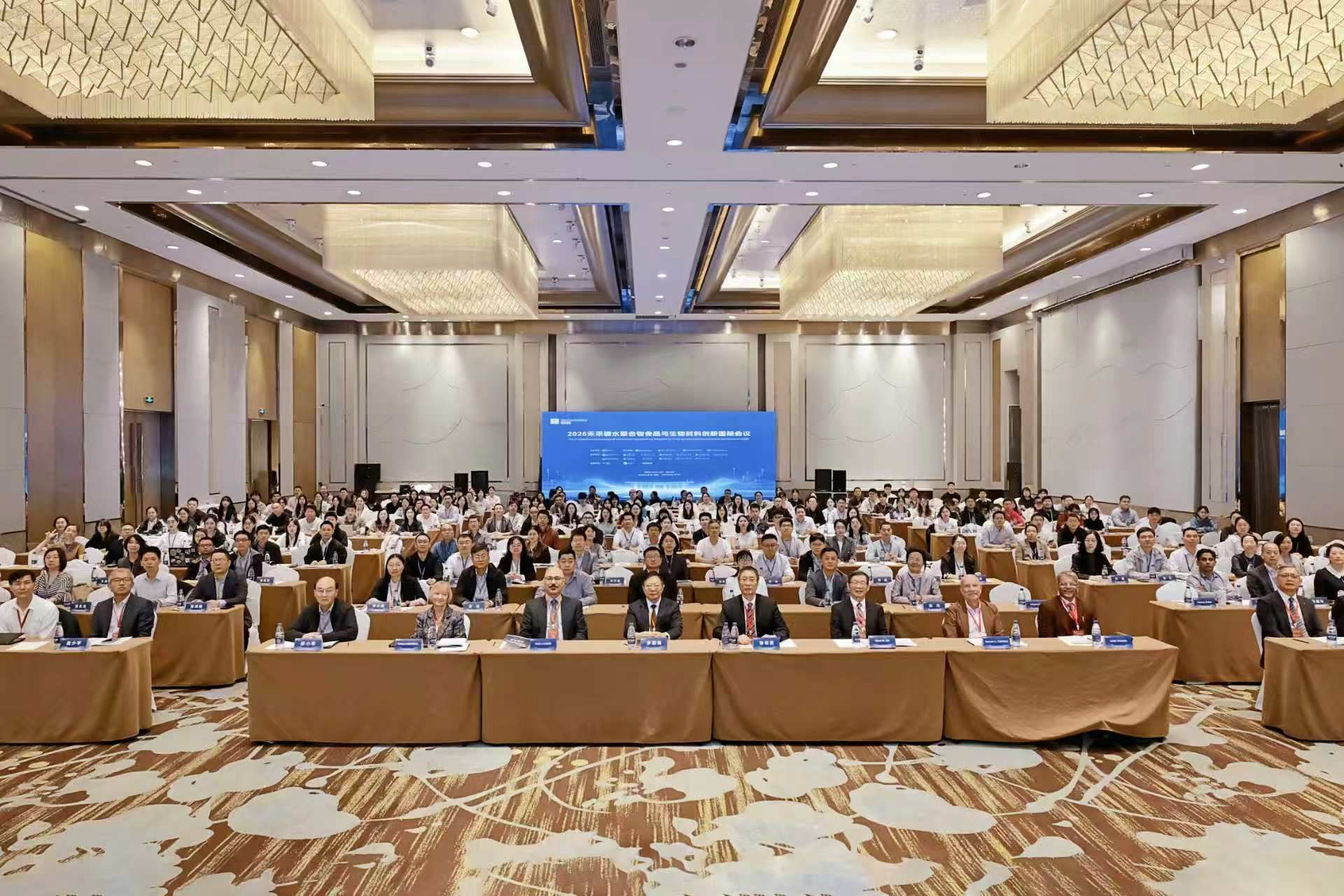
The 1st CarboFuture International Conference: Carbohydrate Polymers for Food and Biomaterial Innovations (CarboFuture-2026) officially opened on October 24, 2026, in Nanchang, Jiangxi Province. The conference was hosted by Nanchang University and co-organized by the Jiangxi Institute of Food Science and Technology, the School of Food Science and Technology of Nanchang University, and the State Key Laboratory of Food Science and Resources of Nanchang University. The conference focused on the structure, functionality, and processing technologies of carbohydrate polymers and their roles in food systems and human health, while also highlighting the integration of artificial intelligence and data-driven approaches into the intelligent development of carbohydrate polymer functions and health-related characterization and discovery.
The opening ceremony was addressed by Professor Luo Sihai, Party Secretary of Nanchang University; Professor Xie Mingyong, Honorary Chair of the Conference, Academician of the Chinese Academy of Engineering, and Director of the State Key Laboratory of Food Science and Resources of Nanchang University; and Professor Pedro Fardim, Co-Honorary Chair of the Conference, President of the European Polysaccharide Network of Excellence (EPNOE), and Professor at KU Leuven in Belgium. On behalf of Nanchang University, Professor Luo Sihai extended a warm welcome to the participating experts and scholars, and introduced the university's achievements in institutional development and its progress in food science. Professor Xie Mingyong, on behalf of the conference organizing committee, delivered a welcome address outlining the conference themes and Nanchang University's research layout in the field of carbohydrate polymers. Professor Pedro Fardim reviewed the cooperation between EPNOE and Nanchang University, and spoke highly of the significance of the conference in advancing international academic exchange in carbohydrate polymers. Professor Nie Shaoping, Chair of the Conference and Vice President of Nanchang University, attended the opening ceremony and delivered an academic presentation during the plenary session.
In the plenary session, eight renowned scholars from China and abroad delivered presentations. Professor Pedro Fardim discussed the biomanufacturing and functionalization strategies of pullulan and its transformation into multifunctional advanced biomaterials. Professor Steve W. Cui (Dalian Polytechnic University; Agriculture and Agri-Food Canada; President of the International Hydrocolloids Society) systematically reviewed the current state of marine polysaccharide research and outlined future directions in food and biomaterial applications. Professor Manuel A. Coimbra (University of Aveiro, Portugal; Editor-in-Chief of Carbohydrate Polymers) explored how polysaccharide application research can serve as a bridge between academia and the food industry. Professor Ding Kan (Shanghai Institute of Materia Medica, Chinese Academy of Sciences) presented the latest progress in polysaccharide-based innovative drug development. Professor Tatiana Budtova (MINES Paris-PSL, France; Editor-in-Chief of Carbohydrate Polymers) introduced the emerging applications of bioaerogels, ranging from thermal insulation materials to food additives and cosmetics. Professor Nie Shaoping presented research advances on the role of bioactive polysaccharides in health regulation. Professor Sabu Thomas (Mahatma Gandhi University, India) reported on the latest developments in advanced polymer composites and nanocomposites, while Professor Han Quanbin (Associate Dean of the School of Chinese Medicine, Hong Kong Baptist University) delivered a keynote lecture on polysaccharides and traditional Chinese medicine research. At the closing ceremony, Professor Wu Jianyong, Chair of the Conference Organizing Committee and Distinguished Professor at Nanchang University, reviewed the academic exchanges during the conference, expressed gratitude to all participating scholars at home and abroad and the organizing committee, and expressed the hope that the conference would serve as a catalyst for deepening international exchange and cooperation in the field of carbohydrate polymers.
The conference featured multiple parallel sessions and poster display sessions, with in-depth discussions covering the bioactivity, nutritional functions and mechanisms of carbohydrate polymers, structural characterization and processing technologies, as well as AI- and data-driven intelligent development. Prior to the main conference, a Young Scholars Forum and a Graduate Student Forum were held, providing young researchers with opportunities for face-to-face exchanges with journal editors-in-chief. The conference received support from journals including Carbohydrate Polymers and Food Frontiers.
The conference was attended by 20 overseas experts and scholars from Belgium, Portugal, France, Sweden, New Zealand, Canada, Singapore, South Korea, Poland, India, Egypt, Australia, the United States, the United Kingdom, Austria, and other countries and regions, as well as nearly 300 experts, scholars, and representatives from more than 70 leading universities, research institutions, and enterprises in China, attended the conference.